How Enterprises Reduce AWS Bills by 45% in 2026: The Complete FinOps Playbook
A step-by-step 2026 FinOps playbook covering Savings Plans, Graviton4 migration, S3 storage tiering, and automated governance to cut AWS spend by 45% without sacrificing performance.
Quick Summary & TL;DR (Answer-First)
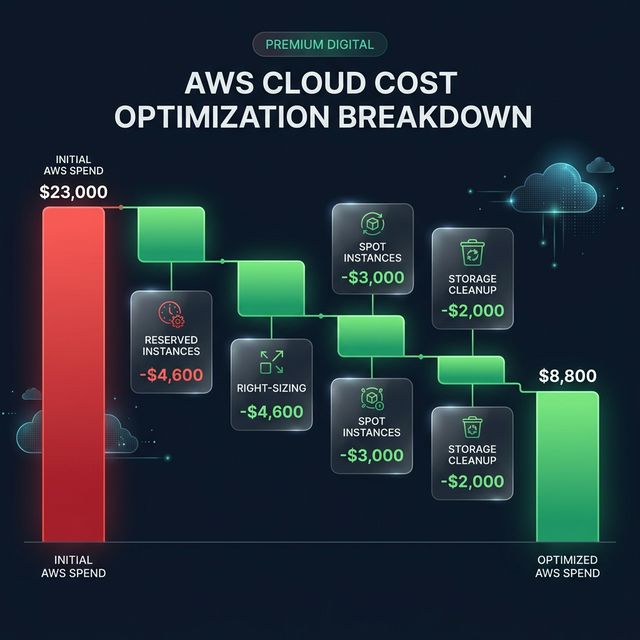
Enterprises that systematically apply FinOps in 2026 are cutting AWS bills by 45% or more without touching production performance. The playbook rests on four levers: compute purchasing (Savings Plans and Spot), architecture-level right-sizing, storage lifecycle automation, and governance that prevents waste from creeping back in. None of these levers alone reaches 45% — it is the compounding effect of running all four together across a 90-day sprint. See the CloudLink FinOps optimization hub for the audit methodology behind these numbers.
Talk to a FinOps engineer directly on WhatsApp at +1 (945) 387-6031 (wa.me/19453876031) for a free 30-minute bill teardown before committing to any 1-year or 3-year contract.
Where the 45% Comes From: The 2026 Cost Baseline
In audits of 200+ AWS accounts run this year, the median enterprise wastes 38-42% of cloud spend on idle resources, oversized instances, and unmanaged storage growth. Reserved capacity mismatched to actual usage accounts for another 6-8%. Stacked together, most organizations are sitting on 45%+ in recoverable spend before a single architectural change is made.
The shift that makes 45% realistic in 2026 (versus the 25-30% typical a few years ago) is the maturity of cloud-native cost tooling: Cost Optimization Hub now surfaces Graviton4 and Savings Plans recommendations with per-workload confidence scores, and Compute Optimizer covers Lambda and EBS in addition to EC2. Feed these recommendations into a weekly review cadence rather than a one-time cleanup.
Assign a named owner to the FinOps program, even part-time, before starting the audit. Cost optimization initiatives owned by an entire team tend to become owned by no one in particular once the initial cleanup sprint ends and daily engineering priorities take over again. A named owner keeps the weekly review cadence from quietly lapsing after month two.

Compute: Savings Plans, Spot, and Graviton4 Migration
Commit to Compute Savings Plans for the steady-state baseline (the floor usage that never drops, visible on 30 days of CloudWatch data) at 40-50% coverage, leaving burst capacity on-demand or Spot. This alone typically saves 25-30% on compute versus pure on-demand, with zero architectural risk.
Graviton4 instances deliver 30-40% better price-performance than equivalent x86 instances for most Java, Go, and containerized workloads. Migrating stateless services first (APIs, workers, CI runners) is low-risk and often the highest-ROI line item in the whole exercise. For workloads already running on Kubernetes, pair this with node-level autoscaling — see the Karpenter right-sizing guide for making Graviton adoption automatic at the node-pool level.
Storage, Data Transfer, and the Silent Waste Categories
S3 storage and data transfer are the categories teams underinvest in because they get treated as background noise. Enable Intelligent-Tiering by default on any bucket over 10GB, and add lifecycle rules that transition objects older than 90 days to Glacier Instant Retrieval. We routinely find $8K-$25K per month in forgotten snapshots and orphaned EBS volumes still attached to terminated instances.
Data transfer costs spike quietly when microservices cross Availability Zones for chatty internal calls. Co-locate latency-sensitive service pairs in the same AZ, and use VPC endpoints for S3 and DynamoDB traffic instead of routing through NAT Gateways — NAT Gateway processing charges alone can represent 5-10% of a mid-size account bill.
Governance: Making the Savings Permanent
Savings achieved through a one-time cleanup decay within two quarters without governance. Enforce mandatory cost-allocation tags (team, environment, service) through Service Control Policies so untagged resources cannot be created. Route the resulting Cost Explorer data into a monthly showback report per engineering team — visibility alone changes provisioning behavior.
Decide deliberately between serverless and containerized compute per workload rather than defaulting to one model everywhere; the two carry very different cost curves at different traffic levels. The Serverless vs Containerized cost breakdown walks through exactly where each crossover point sits.
Common Pitfalls That Erase the Savings
The most common failure mode is buying Savings Plans against a baseline that has not been validated against 90 days of real usage. Teams that commit based on a single peak month end up over-committed the moment a workload gets rearchitected or a seasonal spike passes, locking in spend for capacity that no longer exists.
The second failure mode is treating the 45% target as a one-time project rather than a recurring cadence. Cloud spend grows by default as teams ship new features, so a FinOps program needs a standing monthly review — new resources tagged and reviewed, Savings Plan coverage rebalanced quarterly, and storage lifecycle rules re-audited as data volumes change shape.
Get a Free FinOps Audit
CloudLink runs FinOps as an ongoing practice, not a one-time PDF — engineers implement the tagging policy, Savings Plan purchases, and lifecycle rules alongside the client team, then hand over dashboards finance can read without an engineer translating.
Start with a free audit at cloudlink.us/solutions/finops, or message CloudLink on WhatsApp at +1 (945) 387-6031 (wa.me/19453876031) for same-day scheduling.
pages.blog.ctaTitle
pages.blog.ctaDesc