Cut Your Cloud Bill by 40% in 30 Days
Systematic FinOps approach to eliminating wasted spend across AWS, GCP, and Azure. Real savings from 200+ infrastructure audits.
The FinOps Framework
Cloud cost optimization isn't about cutting corners — it's about eliminating waste. In our experience auditing 200+ infrastructures, the average company wastes 35-40% of their cloud spend on idle resources, oversized instances, and zombie infrastructure.
The FinOps framework organizes cost optimization into three phases: Inform (visibility), Optimize (right-sizing), and Operate (governance). We'll focus on quick wins that deliver 40%+ savings in 30 days.
Week 1: Quick Wins (15-20% savings)
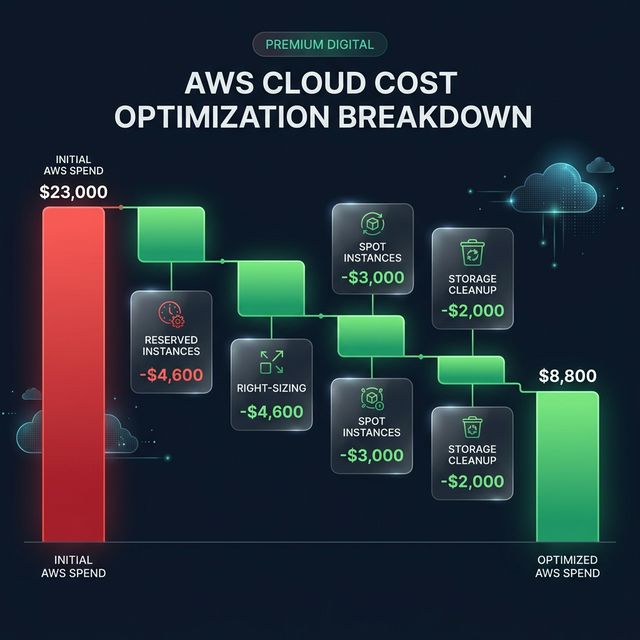
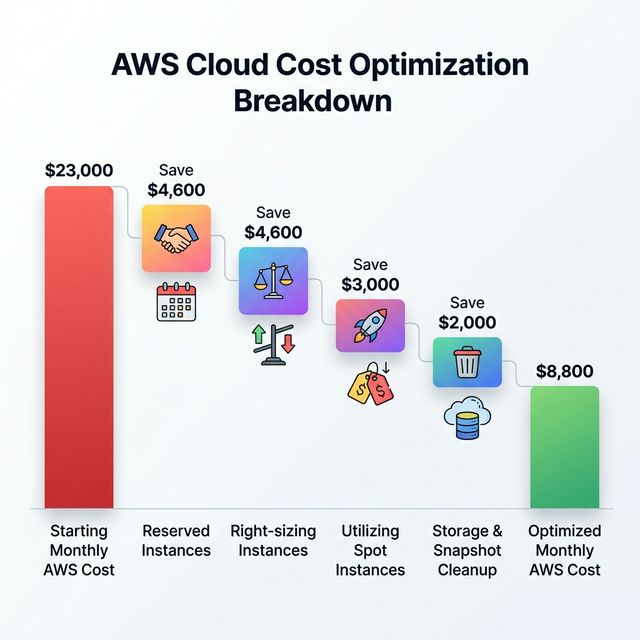
Start with Reserved Instances and Savings Plans. If you have steady-state workloads, 1-year no-upfront RIs save 30-40% versus on-demand. For variable workloads, use Compute Savings Plans for 20% savings with full flexibility.
Delete unused resources: old snapshots, unattached EBS volumes, idle load balancers, and forgotten development environments. We routinely find $2K-$10K/month in zombie resources per customer.

Week 2: Right-Sizing (10-15% savings)
Use AWS Compute Optimizer or Datadog to identify oversized instances. Most teams provision for peak and never revisit. Right-sizing from m5.2xlarge to m5.xlarge saves 50% per instance.
For containers on EKS/ECS, implement Horizontal Pod Autoscaling (HPA) and Cluster Autoscaler. Set requests to P50 usage and let the autoscaler handle peaks.
Week 3-4: Architectural Optimization
Migrate stateless workloads to Spot Instances with fallback to on-demand using mixed instance groups. We see 60-80% savings on Spot for batch processing, CI/CD runners, and dev environments.
Implement S3 Lifecycle policies to transition old data to Glacier. Use CloudFront for static assets to reduce data transfer costs. Consider graviton/ARM instances for 20% price-performance improvement.
pages.blog.ctaTitle
pages.blog.ctaDesc