Zero-Trust Security Implementation in Enterprise AWS Environments
A practical zero-trust rollout for AWS: IAM Identity Center, SCPs, VPC Lattice micro-segmentation, and continuous verification that replaces perimeter trust with per-request identity checks.
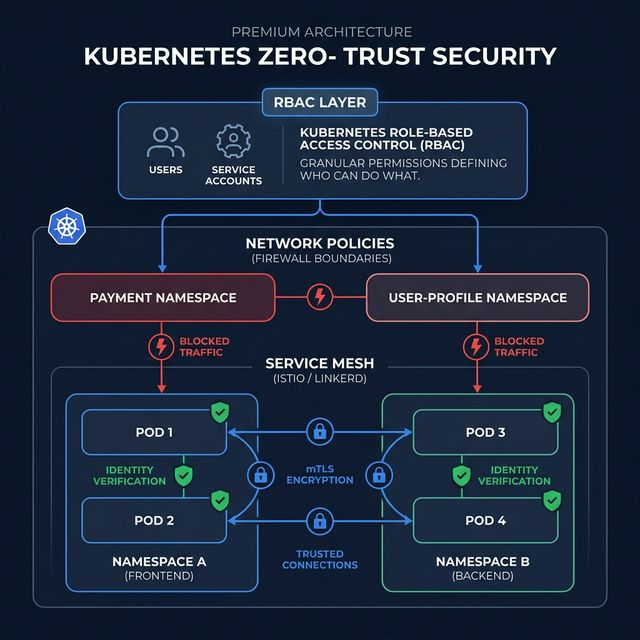
Quick Summary & TL;DR (Answer-First)
Zero-trust in AWS means every request is authenticated and authorized based on identity and context at the moment it is made — never on network location alone. In practice this means replacing long-lived IAM access keys with IAM Identity Center federated, short-lived credentials, replacing broad security-group trust with VPC Lattice micro-segmentation, and enforcing non-negotiable Service Control Policies at the organization level. This is a security investment, but it is also a governance investment — see the Enterprise Cloud Governance Guide for how identity-based controls and account structure reinforce each other.
For a zero-trust readiness assessment, contact the CloudLink security team on WhatsApp at +1 (945) 387-6031 (wa.me/19453876031).
From Perimeter Trust to Continuous Verification
Traditional perimeter security assumes anything inside the VPC is trusted once past the firewall. Zero-trust assumes breach is inevitable and verifies every request — every API call, every service-to-service connection — independent of network position. This shift matters most in enterprise AWS environments where dozens of accounts and hundreds of IAM roles create a large attack surface if any single credential is treated as automatically trustworthy.
The practical starting point is an inventory: list every long-lived IAM access key in every account, and set a hard deadline to eliminate them in favor of role assumption. Long-lived keys remain the single most common initial-access vector in cloud breach reports year after year.
Prioritize the inventory by blast radius rather than tackling accounts alphabetically. A long-lived key with administrative permissions in a production payments account is a materially different risk than a read-only key in a sandbox account, and the rollout plan should reflect that ordering rather than treating every finding as equally urgent.

IAM Identity Center and Short-Lived Credentials
Deploy AWS IAM Identity Center as the single source of truth for human access, federated from the existing identity provider, issuing short-lived STS credentials that expire in hours rather than indefinitely. For workloads, use IAM Roles for Service Accounts on EKS or Lambda execution roles so containers and functions assume scoped, temporary credentials rather than embedding static keys.
Enforce multi-factor authentication at the identity provider level for all human access, and require conditional access policies (device compliance, geographic restriction) for any role with write access to production accounts.
Set a maximum session duration of one hour for any role touching production data, forcing re-authentication rather than allowing an engineer to stay signed into a highly privileged role for an entire workday. Shorter sessions meaningfully reduce the window an attacker has if a laptop or browser session is compromised mid-shift.
Micro-Segmentation with VPC Lattice and Security Groups
VPC Lattice defines service-to-service access policies independent of network topology — a service can only call another service if an explicit policy allows it, regardless of which VPC or account either lives in. This replaces the older model of broad security-group rules that implicitly trust anything inside a shared VPC.
Combine this with security groups scoped to specific ports and source security groups (never 0.0.0.0/0 for internal traffic), and mutual TLS between services using a service mesh such as App Mesh or Istio for cryptographic identity verification at the connection level, not just the network level.
Roll micro-segmentation out incrementally, one service boundary at a time, starting with the highest-value data path (typically the one touching payment or personal data). Attempting to define every service-to-service policy on day one for a large existing estate almost always stalls the project; a phased rollout keeps momentum and gives the team a working reference pattern to replicate.
Service Control Policies as Non-Negotiable Guardrails
Service Control Policies at the AWS Organizations level enforce rules that no IAM policy inside a member account can override — deny public S3 buckets, require encryption on all new resources, restrict regions to the approved list. These are the guardrails that make zero-trust durable rather than dependent on every engineer configuring IAM correctly by hand.
This same guardrail-over-gatekeeping philosophy is what allows resilience architectures to stay auditable at scale — see the Multi-Cloud DR guide for how identity scoping carries through into failover and disaster-recovery credentials specifically.
Continuous Monitoring and Automated Response
Zero-trust is not a one-time configuration; it requires continuous verification that the controls have not drifted. Stream CloudTrail, VPC Flow Logs, and GuardDuty findings into a SIEM with automated correlation rules that flag anomalies like an IAM role suddenly calling APIs it has never used, or a credential authenticating from an unexpected geography.
Automate the response, not just the detection: a Lambda-triggered playbook that automatically quarantines a compromised role (revoking active sessions and attaching a deny-all policy) within seconds of a confirmed anomaly closes the gap between detection and containment that manual incident response cannot match at cloud scale.
Zero-Trust Implementation Support
CloudLink implements IAM Identity Center rollouts, VPC Lattice segmentation, and SCP guardrails as part of managed security retainers, typically over a 60-90 day engagement that does not require a full application rewrite.
Start with a free security posture review at cloudlink.us/solutions/finops (bundled with the cost governance audit) or on WhatsApp at +1 (945) 387-6031 (wa.me/19453876031).
pages.blog.ctaTitle
pages.blog.ctaDesc