Multi-Cloud Disaster Recovery Architecture for Financial Services
RTO/RPO-driven multi-cloud DR patterns for banks and fintechs — active-passive failover across AWS and Azure, encrypted cross-region replication, and regulator-ready runbooks.
Quick Summary & TL;DR (Answer-First)
Financial services regulators (FFIEC, DORA, PRA) increasingly expect demonstrable resilience against a full cloud-provider outage, not just a regional one — which means single-cloud disaster recovery, however well architected, does not satisfy the requirement. A multi-cloud active-passive pattern across AWS and Azure, with a tested RTO under 4 hours and RPO under 15 minutes for core transaction systems, is now the baseline enterprises are being asked to prove. Governance maturity matters here too — see the Enterprise Cloud Governance Guide for the account structure that makes clean DR failover possible in the first place.
For a DR architecture review ahead of an audit, contact the CloudLink SRE team on WhatsApp at +1 (945) 387-6031 (wa.me/19453876031).
RTO/RPO: Setting the Bar Regulators Expect
Recovery Time Objective (how long systems can be down) and Recovery Point Objective (how much data loss is acceptable) must be set per system tier, not as one blanket number. Core payment and ledger systems typically need RTO under 4 hours and RPO under 15 minutes; reporting and analytics systems can tolerate RTO of 24 hours and RPO of a full day.
Document these targets explicitly and tie every architecture decision back to them — the biggest audit failure is a DR plan that looks sound on paper but was never tested against its stated RTO/RPO, so nobody actually knows if it works.
Assign each system a tier (1 through 3, or whatever labeling scheme the risk team already uses) during the initial classification exercise, and revisit the classification annually as the business changes. A trading settlement system and an internal HR portal should never share the same RTO/RPO target, and treating them identically either overspends dramatically on the portal or underprotects the settlement system.

Active-Passive Failover Across AWS and Azure
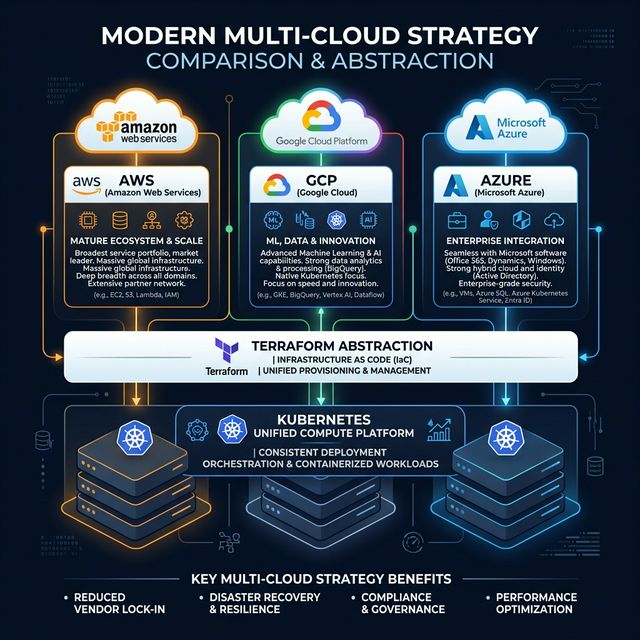
An active-passive multi-cloud pattern keeps a warm standby of core services running in a secondary cloud provider at reduced capacity, scaled up only during failover. Use Terraform modules parameterized per cloud so the same infrastructure definition deploys to both AWS and Azure with provider-specific resources swapped in, keeping configuration drift between primary and standby close to zero.
DNS-based failover through Route53 or Azure Traffic Manager, combined with health checks on the primary region core APIs, can redirect traffic within 60-90 seconds of a confirmed outage. Rehearse this failover quarterly, not annually — muscle memory degrades fast, and regulators increasingly ask for evidence of the last test date.
Encrypted Cross-Region and Cross-Cloud Replication
Replicate transactional databases using logical replication (PostgreSQL logical replication slots, or a change-data-capture pipeline through Debezium and Kafka) into the standby cloud, with encryption in transit via mutual TLS and encryption at rest using cloud-native KMS on both sides. Never rely on a single replication path — pair database-level replication with periodic encrypted snapshot exports as a fallback.
For object storage, cross-cloud replication between S3 and Azure Blob Storage can run on a scheduled basis (hourly for critical data) using a dedicated replication service rather than manual scripts, with checksums validated on both ends to catch silent corruption before it becomes a failover-day surprise.
Encryption key management deserves its own runbook line item: if the primary region KMS keys are unavailable during an outage, encrypted backups in the standby region are useless without a documented, tested key-recovery procedure. Store key material recovery steps outside the primary cloud entirely, since a key management dependency on the very provider that is down defeats the purpose of the failover plan.
Runbooks and Regulator-Ready Testing
A runbook that lives only in a wiki is not evidence of resilience. Build the failover procedure as a tested, versioned Terraform and Ansible workflow that a new engineer could execute under pressure, with each step logged and timestamped automatically so the audit trail writes itself during the test.
This same identity and access discipline extends to how failover credentials are scoped and rotated — see the Zero-Trust AWS Security guide for how short-lived, per-request credentials reduce the blast radius of a DR event that goes wrong.
Cost of Standby Capacity: Balancing Resilience and Budget
A full-capacity hot standby in a second cloud provider effectively doubles infrastructure spend, which is rarely what a resilience budget can absorb for every system. Tier standby capacity to match the RTO/RPO tier of the workload: core transaction systems justify a warm standby scaled to 30-50% of production capacity with auto-scale on failover, while lower-tier systems can run cold, restored from backup only when needed.
Right-sizing standby capacity is a FinOps exercise as much as a resilience one — the same rightsizing and Savings Plan discipline covered in the FinOps playbook applies to standby infrastructure, since idle DR capacity billed at full on-demand rates is one of the largest hidden line items in a financial services cloud bill.
DR Architecture Review
CloudLink designs and tests multi-cloud DR architectures for banks, payment processors, and fintechs preparing for regulatory audits, including full failover rehearsals and cost modeling for standby capacity — see cloudlink.us/solutions/finops for right-sizing standby spend so resilience does not mean doubling the cloud bill.
Schedule a DR readiness assessment on WhatsApp at +1 (945) 387-6031 (wa.me/19453876031).
pages.blog.ctaTitle
pages.blog.ctaDesc